Listeners:
Top listeners:
-
 play_arrow



Trump Presses China Over Iran as Fragile Ceasefire Nears Breaking Point

by Emmitt Barry, Worthy News Washington D.C. Bureau Chief
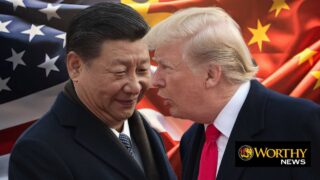
(Worthy News) – President Donald Trump will arrive in Beijing this week for a high-stakes summit with Chinese President Xi Jinping, as Washington intensifies pressure on both China and Iran amid a fragile ceasefire the president described as being on “massive life support.”
The summit comes as the Trump administration expands sanctions against companies and individuals accused of helping Iran move oil, acquire military technology, and sustain the Islamic Revolutionary Guard Corps’ war machine. U.S. officials say Tehran’s ability to fund its nuclear ambitions, terrorist proxies, and regional aggression has been increasingly squeezed by American economic and military pressure.
The Treasury Department announced new sanctions tied to Iranian oil shipments to China, targeting three individuals and nine companies accused of facilitating Tehran’s energy revenues. The move followed a broader sanctions campaign aimed at IRGC-linked financial networks and foreign suppliers aiding Iran’s weapons programs.
The pressure campaign is unfolding alongside the U.S. push to reopen and secure the Strait of Hormuz, one of the world’s most critical oil chokepoints. Ahead of the summit, U.S. officials urged Beijing to use its influence with Tehran to restore stability in the waterway and help de-escalate a crisis that has threatened global energy markets.
China’s Hidden Hand in Iran’s War Machine
While Iran remains the primary aggressor in the region, the Trump administration has sharpened its focus on Beijing’s quiet role in sustaining Tehran’s military capabilities.
The State Department recently announced sanctions against China-based entities accused of providing satellite imagery to help Iran target U.S. forces in the Middle East. Secretary of State Marco Rubio said the United States was acting against firms that supplied imagery and data collection services enabling Iranian military strikes.
Rubio warned that foreign firms ignoring U.S. sanctions would face consequences, including secondary sanctions. That message appears aimed not only at Tehran’s network of suppliers, but at Beijing itself, where Chinese firms have continued operating in defiance of Washington’s pressure campaign.
Treasury Secretary Scott Bessent has framed the sanctions effort as part of the administration’s “Economic Fury” campaign against Iran’s military infrastructure. In a recent Treasury statement, Bessent said the department remained “unrelenting” in targeting foreign individuals and companies providing Iran’s military with weapons for use against U.S. forces.
Beijing has rejected Washington’s sanctions pressure, with Chinese officials signaling that U.S. penalties will not be recognized or implemented by Chinese companies. That resistance now sets the stage for a direct confrontation between Trump and Xi over whether China will continue giving Iran economic and technological breathing room.
Trump Says Iran Ceasefire Is on “Life Support”
Trump’s message on Iran was blunt.
Speaking from the Oval Office, the president said the ceasefire with Iran was on “life support” after rejecting Tehran’s latest peace proposals. Trump reportedly called Iran’s offer unacceptable and warned that the regime could not be allowed to preserve a pathway to nuclear weapons.
“Iran cannot have a nuclear weapon, and they won’t have a nuclear weapon,” Trump said, according to the reports.
The president also suggested that Iran’s ruling system remains divided between those seeking a negotiated settlement and hardliners determined to continue confrontation with the United States and Israel. Trump said he still believes “complete victory” is within reach, even as diplomacy remains uncertain.
For Washington, the central issue remains clear: Iran’s nuclear infrastructure, ballistic missile program, and terror-financing networks cannot be left intact under the cover of another temporary ceasefire.
Religious Freedom Also on the Table
Beyond Iran, oil, trade, and Taiwan, Trump is expected to raise the issue of religious persecution during his meeting with Xi.
The president said he plans to discuss the case of Jimmy Lai, the Catholic Hong Kong media mogul and pro-democracy publisher facing severe punishment under Beijing’s national security crackdown. Trump also said he would raise the case of Pastor Jin Mingri, also known as Ezra Jin, a prominent Chinese house church leader detained amid the Chinese Communist Party’s intensified campaign against unregistered Christian churches.
Rubio has previously described Beijing’s treatment of Christians who reject Communist Party control as evidence of the regime’s hostility toward believers who refuse state interference in their faith.
For Christians worldwide, these cases are not peripheral diplomatic footnotes. They are reminders that behind the great-power struggle between Washington and Beijing are faithful men and women suffering for conscience, truth, and the name of Christ.
A Strategic Moment With Prophetic Weight
This week’s Beijing summit brings together several of the most consequential issues facing the world: Iran’s nuclear threat, China’s global ambitions, the security of the Strait of Hormuz, the survival of a fragile ceasefire, and the plight of persecuted believers under authoritarian rule.
From a biblical perspective, these developments remind believers that the nations are never outside the hand of God. Kings may negotiate, threaten, sanction, and maneuver, but Scripture teaches that the Lord raises up rulers and brings them down according to His purposes.
At such an hour, Christians should pray for wisdom in the halls of power, courage for persecuted believers in China, protection for Israel, and peace in Jerusalem — trusting that the God of Abraham, Isaac, and Jacob remains sovereign over every nation, every ruler, and every battlefield.
Copyright 1999-2026 Worthy News. This article was originally published on Worthy News and was reproduced with permission.
Latest News from Worthy News

A municipal beach worker searching Israel’s Mediterranean coastline for items lost by swimmers discovered something far older than expected: an exceptionally rare 2,500-year-old coin minted in ancient Cyprus.

Health and Human Services Secretary Robert F. Kennedy Jr. said federal investigators spent approximately eight months locating Dr. Anthony Fauci’s private journals, which Kennedy claimed had been scattered across 11 separate government servers.

Skywatchers are preparing for one of the most remarkable astronomical nights of the decade as a total solar eclipse, the peak of the Perseid meteor shower and a broad gathering of six planets converge around August 12.
The United States has condemned the “horrific killing” of nine relatives of Reverend Ezekiel Dachomo, a Nigerian pastor whose earlier appeal warned that “fear has become a way of life” in Nigeria’s violence-plagued Plateau State.
North Korean leader Kim Jong Un marked the 73rd anniversary of the Korean War armistice by paying tribute at war memorials and cemeteries, accompanied for the first time by his daughter, Ju Ae, in a move that analysts say further underscores her increasingly prominent public role.
President Donald Trump said Monday that Iran is seeking negotiations after two weeks of sustained American airstrikes, portraying Tehran’s diplomatic outreach as evidence that the U.S. military campaign has forced the Islamic regime back to the bargaining table.
President Donald Trump and three Republican senators are pressing Senate Majority Leader John Thune to keep the chamber in session through August until lawmakers pass the SAVE America Act, escalating a growing dispute over one of the president’s top election-integrity priorities.