Listeners:
Top listeners:
-
 play_arrow



Trump, South Korea Announce Breakthrough Trade Pact During Gyeongju Summit

by Worthy News Washington D.C. Bureau Staff
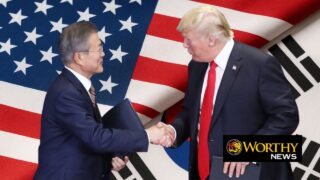
GYEONGJU (Worthy News) – U.S. President Donald Trump and South Korean President Lee Jae Myung announced progress toward a long-sought trade pact Wednesday following a high-profile summit in the historic city of Gyeongju, where Trump was awarded South Korea’s highest state honor.
Trump arrived in South Korea on Oct. 29 to a red-carpet welcome and a military band playing “YMCA,” a song often featured at his campaign rallies. The visit, part of his second-term tour across Asia, coincided with a new North Korean cruise missile test—a reminder of the ongoing regional tensions surrounding Pyongyang’s weapons program.
During his meeting with President Lee, Trump said that a bilateral trade deal—months in the making—was now “pretty much finalized.” The South Korean leader later confirmed that negotiators from both nations had completed the drafting of a $350 billion investment and tariff agreement expected to be announced within days.
Lee awarded Trump the Grand Order of Mugunghwa, the nation’s highest order of merit, praising him as “a peacemaker on the Korean Peninsula.” He also presented Trump with a replica of the ancient Cheonmachong gold crown, symbolizing Silla’s historical unity and a “new era of peaceful coexistence and common growth” between Seoul and Washington.
Key Details of the Trade Deal
According to South Korean officials, the agreement would lower tariffs on most U.S.–bound goods from 25% to 15%, while Seoul commits to $350 billion in American investments and $100 billion in U.S. energy purchases.
Of that investment, $200 billion will be delivered through cash installments and $150 billion through joint shipbuilding ventures.
South Korea’s annual investment would be capped at $20 billion, focused on strategic sectors including semiconductors, nuclear energy, and battery technology. Both nations would split profits evenly until Seoul recoups its initial investment.
The agreement would also exempt generic pharmaceuticals and airplane parts manufactured outside the U.S. from tariffs—a concession viewed as key for Korean exporters.
Kim Yong-beom, South Korea’s presidential chief of staff for policy, described the negotiations as “fierce,” saying the final pact provides “more favorable conditions for Korean markets” compared to other nations negotiating similar agreements with Washington.
A formal signing is expected within days, pending approval by South Korea’s National Assembly. Once ratified, the tariff reductions could take effect retroactively starting Nov. 1.
Regional Context
Trump’s visit to Gyeongju, the ancient capital of the Silla Kingdom, also featured bilateral meetings with regional leaders ahead of this week’s Asia-Pacific Economic Cooperation (APEC) summit. He is scheduled to meet Chinese leader Xi Jinping on Thursday.
At an earlier address to APEC business leaders, Trump said the trade deal with Seoul would be finalized “very soon,” while reaffirming his administration’s focus on correcting trade imbalances and boosting U.S. manufacturing.
Trump’s stop in South Korea follows visits to Malaysia and Japan, where he secured rare-earth supply agreements and new investment pledges totaling nearly $500 billion.
Symbolic Diplomacy and Security Ties
In a ceremonial exchange reflecting historic friendship, Lee and Trump toured a local museum before holding a working lunch focused on defense cooperation. The South Korean leader pledged to increase defense spending in alignment with U.S. regional strategy.
Trump, calling the meeting “tremendous,” said the day’s events marked “a new chapter in our economic partnership and peace for the Korean Peninsula.”
Later Wednesday, the two leaders joined counterparts from Vietnam, Australia, New Zealand, Canada, Thailand, and Singapore for a state dinner ahead of the APEC sessions.
Copyright 1999-2026 Worthy News. This article was originally published on Worthy News and was reproduced with permission.
Latest News from Worthy News
The Republican-led Senate narrowly rejected another attempt Thursday to force an end to unauthorized U.S. military operations against Iran, preserving President Donald Trump’s ability to continue the campaign without a new authorization from Congress.
Hungary’s only nuclear power plant could be forced to shut down within days after record-low water levels on the Danube River sharply reduced its cooling capacity, raising fresh concerns over Europe’s energy security amid an intense heatwave.
President Donald Trump announced Thursday that Hamas has agreed to a phased process leading to the “complete disarmament” of the terrorist organization and other armed factions in the Gaza Strip, calling the reported agreement a historic step toward lasting peace.
President Donald Trump openly questioned whether Senate Majority Leader John Thune should remain in his leadership post as tensions intensified over the Senate’s failure to advance Trump’s election-integrity agenda.
Senior U.S. intelligence officials have concluded that China’s alleged acquisition of American voter-registration data falls within the government’s definition of foreign election interference, according to information released Thursday by the White House.
The widening war between the United States and Iran entered a dangerous new phase Wednesday as American and Saudi forces carried out coordinated strikes against Iran-backed militias across Iraq, marking the first publicly acknowledged joint combat operation of its kind between Washington and Riyadh.
Spanish authorities warned Wednesday of an “extraordinary, exceptional situation” after hundreds of migrants swam from Morocco to the tiny Spanish territory of Ceuta, overwhelming reception facilities and prompting renewed concern over migration pressures on Europe’s southern border.