Listeners:
Top listeners:
-
 play_arrow



Turkey Unveils Intercontinental Ballistic Missile as Defense Ambitions Accelerate

by Emmitt Barry, Worthy News Washington D.C. Bureau Chief
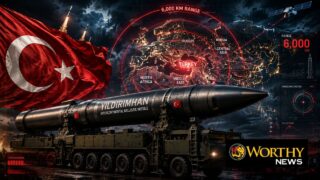
(Worthy News) – Turkey unveiled its first domestically developed intercontinental ballistic missile this week, signaling a dramatic expansion of Ankara’s military capabilities and raising new concerns across Europe, the Middle East, and Asia.
The missile, named the Yildirimhan — a name derived from Turkish words associated with “lightning ruler” or “lord of thunder” — was revealed during the SAHA Expo 2026 defense and aerospace exhibition in Istanbul. The name itself appears designed to project speed, power, and dominance, reflecting Ankara’s growing military ambitions on the world stage.
Developed by Turkey’s National Defense Ministry Research and Development Center, the missile reportedly has a range of up to 6,000 kilometers, placing much of Europe, North Africa, the Middle East, and large portions of Asia within striking distance.
Turkish officials said the missile is capable of carrying a payload of up to 3,000 kilograms and can travel at speeds ranging from Mach 9 to Mach 25. The system reportedly uses liquid nitrogen tetroxide fuel and a four-engine propulsion design.
Turkish Defense Minister Yaşar Güler said the changing global security landscape has accelerated Turkey’s push toward military self-sufficiency.
“Recent wars and conflicts have provided very critical data for security doctrine while also increasing our responsibilities,” Güler said, referencing the Russia-Ukraine war as well as the recent conflict involving Iran, the United States, and Israel.
Turkey has spent recent years aggressively expanding its domestic defense industry after tensions with NATO allies and its removal from the F-35 fighter jet program. Ankara now aims to meet nearly all of its military requirements domestically by 2030.
The Yildirimhan missile is only one part of a much broader military modernization effort underway under President Recep Tayyip Erdoğan. Turkey is also developing the KAAN fifth-generation fighter jet, producing the Altay main battle tank, expanding its naval fleet with new submarines and destroyers, and ramping up production of advanced drones and hypersonic missile systems.
Last week, Turkey also successfully tested the Tayfun Block-4 ballistic missile, which reportedly exceeds Mach 5 speeds and has a range of approximately 800 kilometers. Officials say mass production is expected by 2026.
Meanwhile, Ankara recently launched its $6.5 billion “Steel Dome” initiative, a layered air defense network designed to rival systems such as Israel’s Iron Dome. The project aims to defend Turkish territory against aircraft, drones, and ballistic missile threats.
President Erdogan declared the Steel Dome system “will instill confidence in friends and fear in enemies.”
Turkey’s growing military footprint is increasingly reshaping the strategic balance across the region. Once viewed primarily as a regional NATO power, Ankara is now positioning itself as an independent military and geopolitical force with influence stretching across Europe, the Middle East, Central Asia, and Africa.
Prophetic Implications
For many students of Bible prophecy, Turkey’s rise is drawing renewed attention to the ancient prophecy of Gog and Magog found in Ezekiel 38 and 39. Some prophecy scholars have long associated the land of Magog and regions such as Meshech and Tubal with areas located in modern-day Turkey. While interpretations vary, Turkey’s increasing military assertiveness, strategic alliances, and expanding influence in the Middle East continue to fuel discussions among believers watching for prophetic alignments in the last days.
Copyright 1999-2026 Worthy News. This article was originally published on Worthy News and was reproduced with permission.
Latest News from Worthy News

A municipal beach worker searching Israel’s Mediterranean coastline for items lost by swimmers discovered something far older than expected: an exceptionally rare 2,500-year-old coin minted in ancient Cyprus.

Health and Human Services Secretary Robert F. Kennedy Jr. said federal investigators spent approximately eight months locating Dr. Anthony Fauci’s private journals, which Kennedy claimed had been scattered across 11 separate government servers.

Skywatchers are preparing for one of the most remarkable astronomical nights of the decade as a total solar eclipse, the peak of the Perseid meteor shower and a broad gathering of six planets converge around August 12.

The United States has condemned the “horrific killing” of nine relatives of Reverend Ezekiel Dachomo, a Nigerian pastor whose earlier appeal warned that “fear has become a way of life” in Nigeria’s violence-plagued Plateau State.

North Korean leader Kim Jong Un marked the 73rd anniversary of the Korean War armistice by paying tribute at war memorials and cemeteries, accompanied for the first time by his daughter, Ju Ae, in a move that analysts say further underscores her increasingly prominent public role.
President Donald Trump said Monday that Iran is seeking negotiations after two weeks of sustained American airstrikes, portraying Tehran’s diplomatic outreach as evidence that the U.S. military campaign has forced the Islamic regime back to the bargaining table.

President Donald Trump and three Republican senators are pressing Senate Majority Leader John Thune to keep the chamber in session through August until lawmakers pass the SAVE America Act, escalating a growing dispute over one of the president’s top election-integrity priorities.