Listeners:
Top listeners:
-
 play_arrow



Ukrainian President Open To Resign In Exchange For NATO Membership

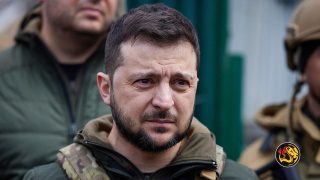
By Stefan J. Bos, Chief International Correspondent Worthy News
KYIVBUDAPEST (Worthy News) – Ukrainian President Volodymyr Zelenskyy says he is willing to step down “immediately” if it secures peace for Ukraine and suggests to trade his resignation for the country’s membership of the NATO military alliance.
He spoke Sunday after Russia carried out its most significant drone attack on Ukraine so far, ahead of the 3rd anniversary of the war, which broke out when Moscow invaded its neighbor on February 24, 2022.
“If peace for Ukraine is at stake, I am ready to leave my post immediately. I can exchange it for NATO membership if those are the terms,” Zelenskyy told reporters Sunday. Both the United States and Russia are against Ukraine joining NATO.
At a press conference in Kyiv, Zelenskyy also expressed his desire to work with U.S. President Donald J. Trump as a partner rather than just a mediator between Kyiv and Moscow. “I really want it to be more than just mediation. That is not enough,” he stated.
Zelenskyy requested an urgent meeting with Trump to discuss a deal granting Washington access to Ukraine’s natural resources in exchange for security guarantees.
He wants the meeting to occur before Trump talks with Russian President Vladimir Putin on a potential peace agreement.
Yet many of the mineral resources the Trump administration is seeking as compensation for U.S. wartime support are located in Russian-occupied regions of Ukraine, Vice Prime Minister Yulia Svyrydenko revealed Sunday.
$350 BILLION
“Unfortunately, an estimated $350 billion worth of valuable and rare materials are currently in temporarily occupied territories,” Svyrydenko explained.
Much of this wealth lies in the eastern Donbas region, controlled by pro-Russian forces since 2014 and later seized by Russian troops.
Frustration is growing in Washington over Ukraine’s reluctance to accept U.S. proposals for the $500 billion resource compensation deal. Zelenskyy has reportedly rejected the offer, viewing it as “a sell-off” of Ukraine’s natural assets.
He maintains that any agreement must include military guarantees from the U.S.
Ukraine is rich in oil, coal, lithium, titanium, uranium, and rare earth metals—key resources for global industries
Yet, U.S. Treasury Secretary Scott Bessent said a potential accord between the United States and Ukraine over mineral resources would not include military security guarantees, contracting Zelenskyy’s views.
In an interview with broadcaster Fox News, Bessent said such a deal would instead serve as an “implicit U.S. guarantee” of heavy investment in Ukraine’s economic future. “I call it an economic security guarantee,” he explained.
DEAL SOON?
Despite tensions, both sides insist negotiations are ongoing. Trump’s special envoy, Steve Witkoff, explained Sunday that he expects a deal to be finalized in the coming week.
However, it was not immediately clear how the different views on ending the war could be reconciled.
Zelensky also noted that Ukraine is still waiting “on approximately $15 billion” in previously pledged U.S. military aid. He hopes that meetings with foreign leaders on Monday—the third anniversary of Russia’s full-scale invasion—will mark a “turning point” in the armed conflict.
Yet uncertainty over Trump’s stance on Ukraine has sparked fears in Kyiv, including Ukraine’s reliance on the Starlink satellite communication system, owned by Trump ally Elon Musk.
Ukrainian Defense Minister Rustem Umerov said Sunday that Ukraine is exploring alternatives, as both Musk and Trump have opposed prolonging the war.
There are concerns that Trump could use Starlink as leverage against Zelenskyy, say sources familiar with the president’s thinking, potentially pressuring Ukraine into accepting terms more favorable to the U.S.
European Union leaders share Zelenskyy’s concerns, and they will hold an “emergency European Council summit” on March 6 in Brussels, Belgium.
European Council President António Costa confirmed the gathering on social media platform X. They are due to focus their attention on the bloodshed in Ukraine and European defense strategy, European sources said.
Copyright 1999-2026 Worthy News. This article was originally published on Worthy News and was reproduced with permission.
Latest News from Worthy News

A Dutch community remained in shock Saturday after a 13-year-old girl was detained following the discovery of her parents’ bodies in their home in the northern Netherlands.
Bolivian President Rodrigo Paz declared a 90-day state of emergency Saturday, empowering the military to clear road blockades after nearly 50 days of anti-government protests that have included widespread road blockades, leaving at least 14 people dead and crippling the nation’s economy.

A powerful thunderstorm system sweeping across Western Europe killed at least one person in the Netherlands, injured several others in Belgium and Germany, and caused widespread damage as nearly 190,000 lightning flashes illuminated the skies, authorities said Saturday.

Israeli strikes killed at least 10 people in Lebanon on Saturday despite a ceasefire that took effect hours earlier, officials said, with Israel claiming it was responding to attacks by the Iran-backed Hezbollah group.

Israel and Iran-backed Hezbollah have agreed to a ceasefire that was to begin Friday afternoon, Worthy News learned.

At least 10 people, including four children, were injured in a Russian strike on Ukraine’s northeastern Kharkiv region, Ukrainian authorities said Friday. In southern Ukraine, the State Emergency Service reported that one person was killed and four others were injured in a separate Russian attack on the Odesa region.

President Donald Trump signed the temporary peace deal with Iran ahead of schedule Wednesday at the Palace of Versailles in France, kicking off negotiations over a final nuclear deal.