Listeners:
Top listeners:
-
 play_arrow



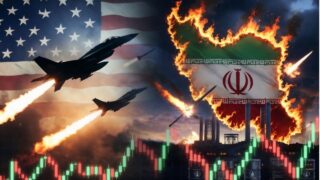
Oil Surges As US Expands Iran Strikes While Tehran Executes Protesters

by Stefan J. Bos, Worthy News Chief International Correspondent
TEHRAN/JERUSALEM (Worthy News) – A gallon of regular gasoline in the United States climbed to about $4 and benchmark Brent crude rose above $90 a barrel Monday, further fueling a global energy crisis after the United States launched fresh airstrikes against Iran following the death of another American service member, while Tehran executed at least two more anti-government protesters.
The fighting shattered hopes of a quick solution to the conflict, in which U.S. and Israeli forces say they are seeking to halt Iran’s nuclear program and weaken Tehran’s support for proxy groups committed to Israel’s destruction and hostile to the United States.
The U.S. struck sites near the northwestern city of Tabriz, believed to host underground Iranian missile bases, while Tehran retaliated by launching attacks toward Bahrain, home to the U.S. Navy’s Fifth Fleet, and Kuwait. “Several nights we haven’t been able to sleep. Please pray for us,” a strategically located Filipino Christian domestic worker in Bahrain, who regularly provides updates to Worthy News, said. Shortly afterward, Bahrain activated missile warning sirens Monday as Iranian missiles approached the island kingdom.
The latest attacks underscored that Washington and Tehran have edged closer to all-out war after last month’s interim agreement aimed at permanently ending the conflict crumbled. Shipping through the Strait of Hormuz has largely stalled, while both sides have targeted infrastructure relied upon by millions of civilians.
IRAN EXECUTIONS
The renewed fighting came as suffering also increased inside Iran, where authorities executed two protesters linked to demonstrations against the country’s Islamic rulers, human rights monitors said.
Iranian reporting confirmed the executions of Erfan Esfandiari and Gol Mohammad Mohammadi, an Afghan national, in connection with protests that erupted in Isfahan on January 8.
Iran Human Rights and other Iranian sources said the two men were hanged Sunday, July 19, at Isfahan’s Dastgerd Central Prison. Official reporting confirmed the executions but did not publicly specify where they were carried out.
Their deaths brought the number of protesters reportedly executed in connection with the January 2026 demonstrations to at least 23, according to informed Iranian sources. Another protester, Mohammad Amini Dehaghani, was reportedly hanged at the same prison six days earlier.
“With the breakdown of the ceasefire and the resumption of the war, we are deeply concerned that the authorities will exploit the situation to intensify the execution of political prisoners,” said Mahmood Amiry-Moghaddam, director of the Norway-based Iran Human Rights organization.
EXECUTION FEARS
“Hundreds of political prisoners and protesters are currently facing capital charges, and we estimate that around 100 have already been sentenced to death,” he added.
Amiry-Moghaddam urged the international community, particularly the European Union, to make “an immediate moratorium on executions” a central issue in negotiations with the Islamic Republic.
Iranian authorities have portrayed those executed as responsible for serious crimes during the unrest, but rights groups have repeatedly raised concerns about allegations of torture, coerced confessions, secret proceedings and a lack of access to independent lawyers.
As tensions mounted inside Iran and across the Middle East, higher energy prices were already being felt worldwide. Brent crude trading above $90 a barrel added pressure to inflation, while the rise in U.S. gasoline prices threatened to weigh on consumers and businesses ahead of this autumn’s congressional midterm elections.
The U.S. military said the latest American casualty occurred Saturday in Iraq during the controlled detonation of a downed Iranian drone.
ENERGY SHOCK
The death brought the number of U.S. service members killed since the war began on February 28 to 17, with more than 420 wounded, highlighting the mounting human cost for American forces deployed across the Middle East.
“We hit them very hard again tonight, and we did that in honor of the, probably three, it’s probably three great patriots,” U.S. President Donald Trump said.
The U.S. military’s Central Command later confirmed it had launched its ninth consecutive night of strikes against Iran, targeting military command centers, air-defense and coastal-surveillance sites, maritime capabilities, missile and drone launch sites, and communications networks.
Iran’s state-run IRNA news agency said at least one person was killed in strikes around Tabriz, roughly 520 kilometers, or 325 miles, northwest of Tehran. The city is believed to host underground missile bases operated by Iran’s paramilitary Revolutionary Guard.
Additional attacks reportedly targeted Bandar Imam Khomeini in Khuzestan province, Sirik and Jask in Hormozgan province, and Konarak and Chabahar in Sistan and Baluchistan province.
STRAIT OF HORMUZ
As the strikes unfolded, a commercial vessel caught fire in the Strait of Hormuz after being hit by a projectile near Oman’s coastline, according to the British military’s United Kingdom Maritime Trade Operations center. Its crew abandoned the vessel, which remained adrift and ablaze.
The route near Oman had been recommended by the U.S. military to help ships avoid waters more directly controlled by Iran. Yet even that corridor has become increasingly dangerous. Iran’s Revolutionary Guard later said it was targeting tankers in the strategic waterway.
Tehran has broadened its retaliation against U.S.-allied countries across the Middle East. Besides Bahrain, Kuwait said its air defenses engaged an incoming Iranian barrage, while Iranian forces also claimed attacks against American military positions in Jordan and Syria.
The expanding conflict has heightened anxiety across Gulf states hosting American forces, including Qatar, the United Arab Emirates, Saudi Arabia, Bahrain, Kuwait and Iraq.
Governments across the region have reinforced security around military installations, airports, ports, desalination facilities and energy infrastructure vital to millions of people and the global economy.
DIPLOMACY UNCERTAIN
The Strait of Hormuz, through which roughly one-fifth of globally traded oil passed before the war, remains central to the confrontation. Trump has threatened strikes against Iran’s power stations and bridges to pressure Tehran to loosen its hold over the strategic waterway.
The United States has meanwhile reimposed a naval blockade on Iranian ports aimed at restricting Tehran’s crude-oil exports. The military said it had redirected six vessels and disabled another since implementing the operation.
Despite the escalating military campaign, U.S. Secretary of State Marco Rubio said Washington remained willing to negotiate.
“We’re going to continue to respond. If the door opens to diplomacy—that’ll be a very positive development,” Rubio said. “That’s not where we are tonight, unfortunately.”
Iranian Foreign Ministry spokesperson Esmail Baghaei confirmed that proposals conveyed through mediators had reached Tehran but declined to discuss their contents.
PEACE EFFORTS
Former Iranian Foreign Minister Mohammad Javad Zarif, writing in the Foreign Policy publication, argued that only diplomacy, a new peace agreement and a regional security framework could ultimately end the conflict.
However, he also warned Tehran that repeatedly threatening maritime traffic through the Strait of Hormuz risked turning much of the world against Iran.
Iranian authorities said at least 50 people were killed and 517 wounded in the latest rounds of U.S. strikes as the conflict sent shockwaves through global energy markets, threatened one of the world’s most important shipping lanes, and raised fears of a widening regional war.
Copyright 1999-2026 Worthy News. This article was originally published on Worthy News and was reproduced with permission.
Latest News from Worthy News

The U.S. House of Representatives has approved legislation that could suspend American assistance to Nigeria unless its government takes measurable steps to protect Christians and prosecute those responsible for religiously motivated violence.
The Lebanese Armed Forces began operations Monday to assume security responsibility in three southern villages, marking the first on-the-ground test of a U.S.-brokered framework aimed at securing an eventual Israeli withdrawal and dismantling Hezbollah’s military presence in the region.
President Donald Trump signed an executive order Monday aimed at strengthening America’s defense industrial base and reducing the military’s dependence on China and other foreign suppliers for critical materials and components.

President Donald Trump declared Monday that Israeli Prime Minister Benjamin Netanyahu will not be arrested during his expected visit to New York City for the United Nations General Assembly in September.

Archaeologists have uncovered massive wooden beams believed to have been burned during the Babylonian destruction of Jerusalem nearly 2,600 years ago, offering a rare and tangible connection to one of the most devastating events recorded in Biblical history.
An Iranian ballistic missile that killed two American soldiers at a Jordanian air base struck prefabricated housing where U.S. troops lived and slept, according to American officials cited in an exclusive Wall Street Journal report.

Andy Burnham became Britain’s new prime minister on Monday, replacing Keir Starmer after a Labour Party revolt and vowing a tougher approach toward Israel as part of an agenda that also includes sweeping economic reforms and devolving power from Westminster.