Listeners:
Top listeners:
-
 play_arrow



The Mark of the Beast? The Tech Is Already Here

by Emmitt Barry, Worthy News Washington D.C. Bureau Chief
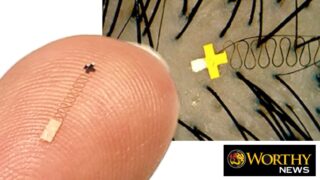
(Worthy News) – In a major breakthrough for wearable technology and neurointerface development, researchers at the Georgia Institute of Technology have created an almost invisible brain sensor small enough to fit between human hair follicles and just beneath the skin. While hailed as a marvel of biomedical engineering, the technology has also sparked alarm among Bible prophecy watchers who see it as yet another sign that the infrastructure for the “mark of the beast” is rapidly falling into place.
The revolutionary device promises to transform the future of brain-computer interfaces (BCIs), enabling continuous and reliable neural signal capture during daily life — without the need for bulky helmets or invasive implants.
The microneedle-based sensor, developed under the leadership of Professor Hong Yeo, integrates advanced conductive polymer materials and flexible wiring into a package smaller than one millimeter. Unlike traditional BCIs that rely on scalp electrodes with conductive gel or surgical brain implants, the Georgia Tech design offers a painless, wireless, and discreet alternative — all while delivering high-fidelity data transmission.
“We discovered that by miniaturizing the sensor to fit between follicles and slightly penetrate the skin, we could dramatically improve signal quality and reduce ambient noise,” explained Yeo, who also serves as a faculty member in Georgia Tech’s Institute for People and Technology.
During recent trials, six participants wore the sensor throughout the day while using it to operate an augmented reality (AR) interface. The device accurately detected visual focus and brain activity for up to 12 hours, enabling users to initiate hands-free video calls and interact with digital content while walking, running, or standing. The study achieved a neural signal classification accuracy of 96.4% — a major advancement for mobile BCI applications.
While many hail the breakthrough as a step forward in human-technology integration, some prophecy watchers are raising serious concerns. They point to Revelation 13, which warns that in the last days no one will be able to buy or sell unless they have the “mark of the beast” — a form of identification tied to allegiance and economic access. The development of subdermal and wearable technologies, especially those that interface directly with the brain or body, is seen by some as a potential stepping stone toward the fulfillment of this prophecy. As these devices become more integrated with daily life and commerce, critics warn that such systems could eventually be used to control the population.
“The moment we start embedding tech under the skin to interface with commerce, communication, and control systems, the prophetic parallels become hard to ignore,” said one prominent Bible prophecy researcher. “This isn’t about the tech itself being evil, but about how such tools could eventually be used to mandate conformity and eliminate personal freedom — precisely what Revelation warns about.”
While this device is not the mark of the beast, the reality is that the technology to develop such systems is already here — a sobering reminder that the prophetic warnings in the Bible are no longer distant speculation, but unfolding possibilities. For those who study end-times prophecy, the rise of implantable and wearable tech should serve as a wake-up call to the rapid acceleration of events foretold in Scripture. What once seemed symbolic or futuristic is now taking physical shape in our generation.
Professor Yeo acknowledged the broader implications of the work but emphasized that the technology is currently focused on medical and rehabilitative applications. “I believe in innovation that helps people,” Yeo said. “We’re building a tool that can restore function and improve lives.”
The Georgia Tech team plans to continue refining the device, eyeing future use in prosthetics, neurological rehabilitation, and next-generation computing. Still, the development is fueling debate over the ethical and spiritual dimensions of merging machines with the human body.
The full study and technical details were published in TechXplore on April 12, 2025.
Copyright 1999-2026 Worthy News. This article was originally published on Worthy News and was reproduced with permission.
Latest News from Worthy News

President Donald Trump signed the temporary peace deal with Iran ahead of schedule Wednesday at the Palace of Versailles in France, kicking off negotiations over a final nuclear deal.

Iran’s Supreme Leader Mojtaba Khamenei’s statement following the signing of a memorandum of understanding with the United States is being viewed by analysts not as an embrace of peace, but as a carefully crafted declaration that preserves Tehran’s revolutionary posture while allowing the regime to regroup.

The United States imposed new sanctions Thursday on individuals and entities linked to Hezbollah, accusing them of using political and financial influence to obstruct Lebanon’s peace process and delay the Iran-backed group’s disarmament.

Ukraine launched one of its largest drone attacks on Moscow since the war began, hitting a key oil refinery and other targets around the Russian capital, leaving at least one person dead and numerous others injured, Russian officials said.

Russian President Vladimir Putin hosted Southeast Asian leaders in Kazan this week as Moscow moved to deepen ties with the Association of Southeast Asian Nations and promote its vision of a “multipolar world order” aimed at countering U.S. global dominance.

Israeli Prime Minister Benjamin Netanyahu said Thursday that Israeli troops will not withdraw from southern Lebanon and will maintain a security zone there for as long as Israel’s defense needs require, placing Jerusalem at odds with both Tehran and the terms of a U.S.-Iran memorandum that calls for an end to hostilities in Lebanon.

U.S. Defense Secretary Pete Hegseth told NATO leaders Thursday that the Pentagon is launching a six-month review of U.S. force posture and basing in Europe, signaling a major push by the Trump administration to ensure European allies assume primary responsibility for defending the continent.