Listeners:
Top listeners:
-
 play_arrow



US and EU Agree On Framework Trade Deal

By Stefan J. Bos, Worthy News Europe Bureau Chief
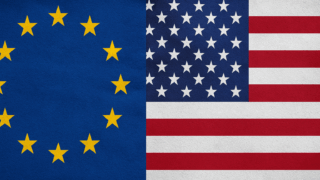
TURNBERRY, SCOTLAND (Worthy News) – In a move expected to be welcomed by anxious financial markets, the United States agreed on a framework trade deal with Europe, although less favorable than the European Union had wanted.
U.S. President Donald J. Trump announced the agreement after the EU’s executive European Commission President Ursula von der Leyen travelled to Scotland to meet him for talks.
The deal, including a 15 percent tariff on EU goods entering the U.S. and significant EU purchases of U.S. energy and military equipment, will bring welcome clarity for EU companies.
It was also aimed to overcome a spiralling row between two allies who account for almost a third of global trade.
However, European critics saw the 15 percent baseline tariff as “a poor outcome” compared to the initial European ambition of a zero-for-zero tariff deal, although it is better than the threatened 30 percent rate.
In remarks to reporters, Trump said the deal would be “great for cars” and would significantly impact agriculture.
MORE DEALS
He added that he is “looking at three or four other countries” to strike deals with, and those deals will most likely include some form of tariffs.
Commentators say Trump wants “to reorder” the global economy and reduce decades-old U.S. trade deficits. So far, Trump has secured agreements with Britain, Japan, Indonesia, and Vietnam.
However, his administration has failed to deliver on the promise of “90 deals in 90 days.”
Yet talking about the deal with the EU, the world’s largest trading bloc, called it “a good deal for everybody.”
He told the media at his golf resort in Turnberry, Scotland, “It’s going to bring us closer together… It’s a partnership in a sense.”
The EU’s chief executive, Von der Leyen, hailed it as a “huge deal,” which she admitted came after “tough negotiations.”
Copyright 1999-2026 Worthy News. This article was originally published on Worthy News and was reproduced with permission.
Latest News from Worthy News

President Donald Trump said Friday that Israel was “very happy” with a newly announced agreement aimed at disarming Hamas, even as Prime Minister Benjamin Netanyahu remained publicly silent and senior Israeli officials indicated that Jerusalem had not accepted the proposal in its current form.

Spain and neighboring Morocco reinforced security around the Spanish enclave of Ceuta after tens of thousands of migrants entered the territory illegally in recent days, while at least 34 people died attempting the dangerous crossing, authorities said Friday.

The Republican-led Senate narrowly rejected another attempt Thursday to force an end to unauthorized U.S. military operations against Iran, preserving President Donald Trump’s ability to continue the campaign without a new authorization from Congress.

Hungary’s only nuclear power plant could be forced to shut down within days after record-low water levels on the Danube River sharply reduced its cooling capacity, raising fresh concerns over Europe’s energy security amid an intense heatwave.

President Donald Trump announced Thursday that Hamas has agreed to a phased process leading to the “complete disarmament” of the terrorist organization and other armed factions in the Gaza Strip, calling the reported agreement a historic step toward lasting peace.

President Donald Trump openly questioned whether Senate Majority Leader John Thune should remain in his leadership post as tensions intensified over the Senate’s failure to advance Trump’s election-integrity agenda.

Senior U.S. intelligence officials have concluded that China’s alleged acquisition of American voter-registration data falls within the government’s definition of foreign election interference, according to information released Thursday by the White House.