Listeners:
Top listeners:
-
 play_arrow



Hungary’s Orbán With Russia-Style Law Launching Crackdown On Dissent

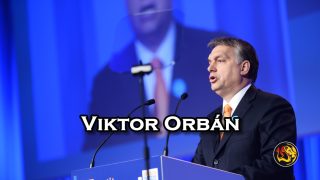
By Stefan J. Bos, Chief International Correspondent Worthy News
BUDAPEST (Worthy News) – Despite ongoing protests, Hungarian Prime Minister Viktor Orbán’s Fidesz party introduced a bill that critics say will lead to a Russia-style crackdown on critics.
The legislation submitted to parliament will blacklist organizations such as media and human rights groups that receive foreign financing and curtail their activities if they are viewed as “a threat to Hungary’s sovereignty.”
In March, Orbán pledged to crack down on foreign funding of independent media, opposition politicians, and non-governmental organizations (NGOs).
During a national holiday rally on March 15, he told his supporters in Budapest, “After today’s festive gathering comes the Easter cleaning. The stink bugs have overwintered.”
He warned: “We will dismantle the financial machine that has used corrupt dollars to buy politicians, judges, journalists, pseudo-NGOs, and political activists. We will eliminate the entire shadow army.”
Wednesday’s submitted legislation seemed part of that pledge ahead of the 2016 elections, when Orbán faces an unprecedented challenge from the new opposition party Tisza, named after Hungary’s second-largest river.
PRIMACY OF MARRIAGE
The legislation would allow the Sovereignty Protection Office (SPO) to draw up a list of foreign-funded legal entities whose activities are considered to”undermine Hungary’s independent, democratic and rule-of-law-based character” or violate Hungary’s constitutional identity or Christian culture.
Challenging the primacy of traditional marriage, the family, and biological sexes would also be considered a threat.
Organisations on the list will have their bank accounts monitored, and funds from abroad considered a threat can be blocked.
If the bill is passed, authorities can enter organisations’ offices and examine their documents and electronic devices.
If an organisation accepts foreign money, it must pay a fine of 25 times the actual funding received. It must cease operations if it cannot pay the fine within 15 days.
The bill was condemned by opposition politicians and independent journalists, likening it to Russia’s so-called “Foreign Agents Law”.
HUNGARY’S ‘RUSSIAN LAW’
Russia first adopted legislation in 2012 allowing authorities to label foreign-funded groups as foreign agents.
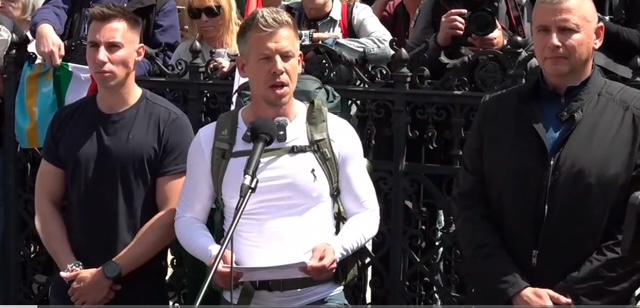
Now, a similar bill was introduced in Hungary, while Tisza leader Péter Magyar launched the “1 million steps for peace” march from the steps of the St. Stephen’s Basilica in Budapest to Romania’s city of Oradea against Orbán’s “autocratic” and “pro-Russia policies.”
“God help me,” Magyar concluded his address to thousands of supporters on Wednesday at the start of the 300-kilometer (186-mile) march toward neighboring Romania.
The march was also held to protest Orbán’s support for an ultranationalist candidate in Sunday’s presidential election in Romania.
Orbán’s backing for George Simion prompted a backlash even in the Hungarian diaspora, potentially jeopardizing the Hungarian leader’s election chances next year.
Romania is home to more than 1 million ethnic Hungarians, many with dual nationality, who have been a crucial source of support for Orbán.
But many have reportedly been furious by his recent endorsement of Simion, who they view as a pro-Russia populist with a history of physical and verbal violence against Hungarian speakers.
Copyright 1999-2026 Worthy News. This article was originally published on Worthy News and was reproduced with permission.
Latest News from Worthy News

Israel and Iran-backed Hezbollah have agreed to a ceasefire that was to begin Friday afternoon, Worthy News learned.

At least 10 people, including four children, were injured in a Russian strike on Ukraine’s northeastern Kharkiv region, Ukrainian authorities said Friday. In southern Ukraine, the State Emergency Service reported that one person was killed and four others were injured in a separate Russian attack on the Odesa region.

President Donald Trump signed the temporary peace deal with Iran ahead of schedule Wednesday at the Palace of Versailles in France, kicking off negotiations over a final nuclear deal.
Iran’s Supreme Leader Mojtaba Khamenei’s statement following the signing of a memorandum of understanding with the United States is being viewed by analysts not as an embrace of peace, but as a carefully crafted declaration that preserves Tehran’s revolutionary posture while allowing the regime to regroup.

The United States imposed new sanctions Thursday on individuals and entities linked to Hezbollah, accusing them of using political and financial influence to obstruct Lebanon’s peace process and delay the Iran-backed group’s disarmament.
Ukraine launched one of its largest drone attacks on Moscow since the war began, hitting a key oil refinery and other targets around the Russian capital, leaving at least one person dead and numerous others injured, Russian officials said.
Russian President Vladimir Putin hosted Southeast Asian leaders in Kazan this week as Moscow moved to deepen ties with the Association of Southeast Asian Nations and promote its vision of a “multipolar world order” aimed at countering U.S. global dominance.