Listeners:
Top listeners:
-
 play_arrow



Syrian President Says Damascus Seeks Security Agreement With Israel

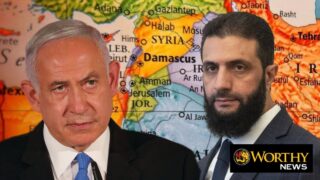
Ahmed al-Sharaa says Syria has “no interest” in confrontation, but insists Damascus will not surrender its claim to the Golan Heights
by Emmitt Barry, Worthy News Washington D.C. Bureau Chief
(Worthy News) – Syrian President Ahmed al-Sharaa said Damascus is seeking a security agreement with Israel that could eventually open the door to broader peace talks, declaring that his government has no interest in entering another military confrontation with the Jewish state.
“We are avoiding confrontation,” al-Sharaa said during an interview broadcast by Al Jazeera. “We have no interest in that.”
The Syrian leader said his government is “working to reach a security agreement with Israel” with assistance from several unnamed countries. He argued that a successful arrangement could establish the groundwork for negotiations toward a more comprehensive peace agreement.
However, al-Sharaa made clear that Damascus would not abandon its longstanding demand for control of the Golan Heights, the strategic plateau Israel captured from Syria during the 1967 Six-Day War and formally annexed in 1981.
The United States recognized Israeli sovereignty over the Golan Heights during President Donald Trump’s first administration in 2019. Syria and most of the international community continue to describe the territory as Syrian land under Israeli occupation.
The renewed public appeal for an agreement follows months of American-mediated negotiations between Jerusalem and Damascus. Talks resumed in January with the stated goal of achieving lasting security, stability and prosperity for both countries.
Yet substantial disagreements remain.
Damascus has demanded that Israel withdraw from military positions it entered following the fall of former Syrian President Bashar al-Assad in December 2024. Israel, meanwhile, has insisted that any agreement must include the demilitarization of southwestern Syria and credible protections for the Druze population.
Israel has said its expanded security presence is necessary to prevent armed Islamist factions from establishing positions near the border and to protect Druze communities that have faced deadly attacks from government-aligned forces and other militias.
Reports from Israel’s northern command have also alleged that forces associated with al-Sharaa’s government transferred weapons and fighters toward strategic hills near Israeli security positions, raising questions about whether Damascus can control—or is willing to confront—the various armed factions operating under its authority.
Al-Sharaa previously led Hayat Tahrir al-Sham and was once associated with an al-Qaeda affiliate before presenting himself as a national leader seeking international legitimacy. His transitional government has promised to protect Syria’s religious and ethnic minorities, although outbreaks of sectarian violence have continued to test those assurances.
The Syrian president also said Damascus does not intend to intervene militarily in Lebanon or launch an operation against Hezbollah.
“The solution there is not necessarily military,” he said, while expressing support for the Lebanese state holding a monopoly over weapons.
His comments came as President Trump has encouraged Syria to prevent Hezbollah from rebuilding supply routes connecting Iran, Iraq, Syria and Lebanon.
Security Arrangement or Genuine Peace?
The distinction between a security arrangement and a full peace treaty remains important.
A limited agreement could establish buffer zones, restrict military movements, reopen diplomatic channels and reduce the immediate danger of accidental escalation. It would not necessarily amount to Syrian recognition of Israel, normalization of relations or an end to the ideological hostility that has shaped relations between the two countries for decades.
Israel and Syria have technically remained in a state of war since Israel’s founding in 1948.
Al-Sharaa’s refusal to relinquish Syria’s claim to the Golan Heights also ensures that one of the most difficult territorial disputes in the Middle East will remain at the center of negotiations.
For Israel, the Golan is not merely symbolic. Its elevation provides a commanding view over northern Israel and serves as a strategic barrier against hostile armies, Iranian proxies and jihadist groups operating inside Syria.
Any Israeli government considering territorial concessions would therefore face the difficult question of whether a future Syrian administration could—or would—prevent hostile forces from returning to the Israeli border.
Prophetic Perspective: “Peace, Peace,” When There Is No Peace
The possibility of reduced hostilities between Israel and Syria should be welcomed. Scripture calls believers to pursue peace, pray for rulers, and seek the welfare of nations.
Yet the Bible also repeatedly warns against confusing diplomatic language with genuine reconciliation.
Through the prophet Jeremiah, the Lord condemned leaders who treated deep national wounds as though they were minor injuries: “They have also healed the hurt of My people slightly, saying, ‘Peace, peace!’ when there is no peace.” — Jeremiah 6:14
Jeremiah repeated the same warning as false prophets promised security while rebellion, deception, and judgment remained unresolved: “For they have healed the hurt of the daughter of My people slightly, saying, ‘Peace, peace!’ when there is no peace.” — Jeremiah 8:11
The prophetic warning does not teach that every peace agreement is false. Neither should Christians reject diplomacy merely because Scripture warns of deceptive peace.
Rather, the passage warns against declarations that conceal unresolved hostility.
A security agreement may restrain armies, establish borders and prevent bloodshed. Those achievements matter. But paper agreements cannot transform hatred, restrain every militia or guarantee that future rulers will honor the promises of those who preceded them.
The apostle Paul similarly warned that the Day of the Lord would come unexpectedly while the world was proclaiming “peace and safety”: “For when they say, ‘Peace and safety!’ then sudden destruction comes upon them.” — 1 Thessalonians 5:3
That passage should produce vigilance, not sensationalism.
The Biblical pattern is clear: believers should pray for peace while refusing to place ultimate confidence in political declarations. Israel’s security will not finally rest upon international pressure, strategic arrangements or the promises of neighboring rulers, but upon the faithfulness of the God of Abraham, Isaac and Jacob.
Diplomacy may restrain conflict for a season. Genuine peace, however, requires more than the absence of war. It requires truth, justice and hearts that no longer seek Israel’s destruction.
Until that deeper transformation occurs, every declaration of peace in the Middle East must be received with hope—but also with watchfulness.
Copyright 1999-2026 Worthy News. This article was originally published on Worthy News and was reproduced with permission.
Latest News from Worthy News

Russia’s attack drones are getting faster, and Ukraine’s defenders are being forced to adapt. New Geran models use turbojet engines instead of the propellers carried by earlier drones, shortening the time between an air-raid warning and a possible strike.

Space Force plans to double in size over the next five years as America’s top military officer calls on U.S. forces to prepare for a battlefield that could extend to the space around the moon.
The United States will continue denying visas to Palestinian Authority officials and members of the Palestine Liberation Organization, a decision that will keep President Mahmoud Abbas and other senior Palestinian leaders from attending next week’s United Nations General Assembly in New York in person. It is the second year in a row that a Palestinian delegation has faced the restriction. The Associated Press reported that Abbas was among those affected.

Vice President JD Vance said the United States should maintain its close partnership with Israel without treating agreement with its government as a condition of that relationship.

The Air Force’s plans for pilotless combat aircraft are moving beyond prototypes. This week, the service gave two of them official names: FQ-42 Vengeance and FQ-44 Fury. It also laid out an ambitious timetable, saying it intends to have 500 combat-ready aircraft by 2032 as part of an eventual fleet of about 1,000.

The Trump administration is looking to Venezuelan oil and domestic production as the war with Iran strains global fuel supplies. Its most immediate test is diesel: the fuel that moves freight, runs farm equipment and helps determine what businesses pay to get goods to market.

For years, Campus Bible Fellowship had a place among the student clubs at SUNY Broome Community College. Now the Christian ministry is in federal court, fighting for the right to choose leaders who share its faith.