Listeners:
Top listeners:
-
 play_arrow



U.S. President Trump Calls War In Iran ‘Small Potatoes’

by Stefan J. Bos, Worthy News Chief International Correspondent
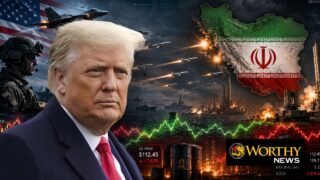
WASHINGTON (Worthy News) – U.S. President Donald J. Trump has called the war with Iran “small potatoes,” despite reports that thousands have been killed across the Middle East, including 18 American military personnel.
Speaking Friday about the armed conflict that has lasted just over six months, Trump compared the deaths of 18 U.S. service members with the wars in Vietnam and Afghanistan, which lasted years and led to the deaths of tens of thousands of American troops.
“I call it a military conflict because it’s small potatoes for us. It’s not a big thing,” Trump told reporters at the White House.
“You know, we do intermittent strikes. So I heard what he said, and it was interesting because I think that there’s a lot of truth that we’re not fighting right now,” the president added, referring to comments by Vice President JD Vance.
Trump acknowledged, however, that “we lost 18 great souls” and stressed that “one is too much.”
COMPARING WARS
“In Vietnam, we lost tens of thousands of people. In Afghanistan, we lost a lot,” Trump said. “What we’ve done is amazing. We took over Venezuela, and we have essentially taken over Iran.”
His remarks came a day after Vance said he would not describe the military hostilities with Iran as a “war,” arguing that major U.S. combat operations had ended months ago despite intermittent fighting.
Asked Friday about Vance’s remarks, Trump appeared to agree with the vice president’s assessment, saying U.S. military action had become intermittent rather than continuous.
Yet Trump also threatened further military action, saying the United States could soon strike Iran’s heavily fortified Pickaxe Mountain site near the damaged Natanz uranium-enrichment facility. The president has repeatedly threatened additional strikes against Iranian targets during ongoing hostilities.
The administration’s characterization of the armed conflict comes as public support for the military campaign has fallen and higher energy prices are increasing economic and political pressure on Trump ahead of November’s midterm elections.
POLITICAL PRESSURE
A Reuters/Ipsos agencies poll released Friday found that only 25 percent of Americans believed the war with Iran was worthwhile, adding to political concerns for Trump and his fellow Republicans.
Trump’s overall approval rating stood at 33 percent in another recent Reuters/Ipsos poll, potentially making him a liability for Republicans as they seek to retain their narrow congressional majorities in the November 3 elections.
The war with Iran has also disrupted global energy supplies, driving up fuel and other costs for Americans and consumers worldwide.
Those economic troubles, combined with public opposition to the war, have put Republicans at risk of losing control of Congress, according to political analysts, while Democrats hope to take over America’s legislature.
Efforts by some Trump administration officials to minimize the effects of the war have drawn sharp criticism from Democrats.
LUTNICK APOLOGIZES
The controversy intensified after U.S. Commerce Secretary Howard Lutnick incorrectly said Wednesday that no American service members had died in the Iran war.
Lutnick apologized Thursday, saying he “misspoke” and had been thinking about the U.S. military operation in Venezuela, where no American service members were killed.
“Eighteen members of our military have died, and to those families my heart breaks and I am so very sorry for their loss,” Lutnick stressed.
The Pentagon has also reported 767 American military personnel wounded during the Iran conflict.
These controversies come as the human cost of just over six months of fighting continues to mount across the Middle East.
THOUSANDS KILLED
Figures compiled from national health ministries and other official bodies six months into the armed conflict indicated that at least 3,527 people had been killed in Iran and more than 4,350 in Lebanon.
Lebanon suffered the largest reported death toll after the Iran-backed Hezbollah group began firing rockets at Israel in support of Tehran on March 2, prompting a major Israeli military offensive.
At least 28 people were reported killed in Gulf states and 60 in Israel, while 18 U.S. service members died in Iranian attacks. Together with the reported deaths in Iran and Lebanon, the figures put the regional death toll at roughly 8,000 by late August.
The casualty figures remain difficult to verify independently and have continued to change as military hostilities persist.
The conflict has also severely disrupted shipping through the Strait of Hormuz, a crucial route for global oil and gas supplies, contributing to higher international energy prices.
WAR BEGINS
The war began February 28 when the United States and Israel launched major coordinated strikes against Iran, targeting the Islamic Republic’s military capabilities, senior leadership, nuclear-related facilities and other strategic sites.
Israel played a central role from the outset, with its air force carrying out extensive strikes in coordination with U.S. forces. Israeli officials described the operation as necessary to counter what they viewed as an existential threat from Iran, including its nuclear and ballistic missile programs.
Iran, which has long denied seeking nuclear weapons, responded with missile and drone attacks against Israel, U.S. military positions and other locations across the Middle East, rapidly widening the fighting beyond Iranian territory.
The hostilities followed a 12-day Israel-Iran war in June 2025, during which the United States also struck Iranian nuclear facilities. Diplomatic efforts to constrain Tehran’s nuclear program continued ahead of the February 2026 attacks but failed to prevent the latest and much longer fighting.
Copyright 1999-2026 Worthy News. This article was originally published on Worthy News and was reproduced with permission.
Latest News from Worthy News

The U.S. economy added 162,000 jobs in August, dramatically exceeding economists’ forecasts and delivering the strongest sign in months that the American labor market remains resilient. The unemployment rate held steady at 4.1%.

A federal judge on Friday extended a block preventing the U.S. Postal Service from enforcing new mail-ballot requirements ordered by President Donald Trump, escalating a legal battle over election procedures less than two months before the November midterms.

Two of U.S. President Donald J. Trump’s top envoys arrived in rainy Moscow on Saturday carrying what he described as a proposal to end Russia’s war against Ukraine, following another round of deadly Russian missile and drone strikes.

Lothar Velten, one of Germany’s best-known evangelists and a leading figure in the nation’s tent mission movement, has died after some six decades of preaching the Gospel in Germany and Austria, his ministry confirmed. He was 82.

U.S. President Donald J. Trump has called the war with Iran “small potatoes,” despite reports that thousands have been killed across the Middle East, including 18 American military personnel.
President Donald Trump warned Friday that the United States may soon strike Iran’s Pickaxe Mountain, a deeply fortified underground site near the Natanz uranium enrichment complex, as tensions over Tehran’s nuclear program continue to sharpen.

The United States, Britain, France, and Germany are pressing the International Atomic Energy Agency’s Board of Governors to report Iran to the U.N. Security Council, accusing Tehran of violating its nuclear obligations and refusing to fully account for its enriched uranium stockpile.